When discussing our impact on the seafood industry and sustainability movements, we rely on the direction of our three strategic pillars. FishChoice’s strategic pillars are the core focus areas that guide its long-term direction and decision-making. They serve as the foundation for our strategy, translating our mission and vision into clear priorities. Each pillar represents a critical area of focus that supports the overall success of the organization. Below are examples of how our work impacts each of these pillars.
FishChoice ensures businesses and stakeholders in the sustainable seafood movement have the information they need to make decisions and take action based on credible, accurate, and timely information.
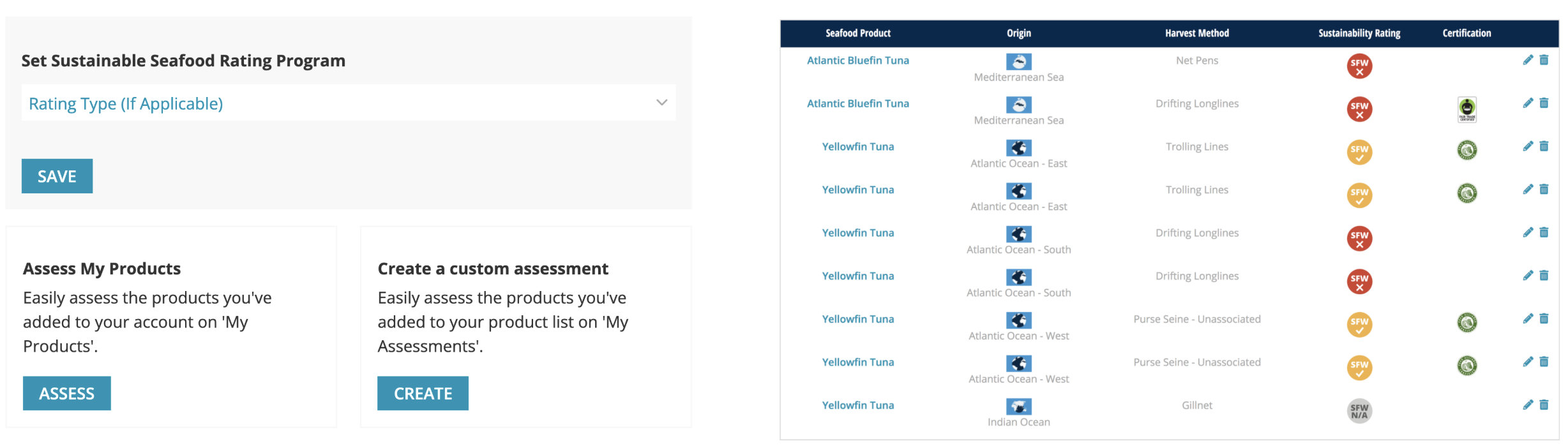
FishChoice’s now-retired My Assessments tool allowed seafood businesses to learn more about the sustainability of their products. Three ratings programs were used to provide the data about seafood products: Seafood Watch, Good Fish Guide, or Ocean Wise. Assessments reported a snapshot of the sustainability of seafood products in real-time by pulling data from a user-generated product list through a simple online form. As sustainability information changed, seafood items in the assessment were automatically updated with any relevant new ratings. This powerful tool changed the way hundreds of seafood businesses understand their products, and how this information could inform their future sourcing decisions.
FisheryProgress’s Follow This FIP feature is a simple but powerful tool that allows businesses to track specific Fishery Improvement Projects (FIPs) of interest. By “following” a FIP, users receive automatic updates whenever there are changes to its profile, such as new progress reports, milestones reached, or shifts in status. This saves companies time from having to manually check for updates and ensures they always have the latest information at hand.
For businesses, the feature is especially important because it provides real-time visibility into the sustainability journey of the fisheries they source from or are considering sourcing from. Having timely, reliable updates helps companies make informed sourcing decisions, demonstrate due diligence to customers and stakeholders, and stay ahead of potential risks in their supply chains. It also makes it easier to show alignment with corporate sustainability commitments by transparently tracking improvements in social and environmental practices.
Follow This FIP acts like a personalized monitoring system, giving businesses efficient access to the most relevant information they need to manage risk, build trust, and strengthen their sustainability strategies.
FishChoice works to develop new tools to increase impact, effectiveness, and efficiency of the global community working to advance sustainable seafood.
Launched in 2016, FisheryProgress is a one-stop shop for information on the progress of global fishery improvement projects (FIPs). FisheryProgress makes tracking progress more efficient, consistent, and reliable for businesses that support FIPs. With the support of FishChoice, FisheryProgress grew out of work by the Conservation Alliance for Seafood Solutions to revise its Guidelines for Supporting Fishery Improvement Projects in 2015. Before FisheryProgress, one of the biggest challenges was that there was no way to know if FIPs meet the guidelines and, more importantly, if they were making progress. Determined to find a solution for this problem, the Alliance revised guidelines to include the creation of an online tool – FisheryProgress – to make FIP progress information easier to access, track, and compare. As a result, FisheryProgress was created and is managed by FishChoice.
FishChoice works to ensure that efforts within its sphere of influence continue to improve seafood sustainability.
The mid-2025 updates to the FisheryProgress Human Rights and Social Responsibility (HRSR) Policy is a clear example of continuous improvement. Instead of being a static checklist, the Policy has evolved—based on stakeholder feedback—to emphasize steady progress, flexibility, and real-world applicability. By allowing FIPs to report on work in progress, address obstacles openly, and benefit from streamlined, less burdensome reporting, the Policy creates an ongoing cycle of assessment, action, and reassessment. This shift ensures accountability while recognizing that meaningful change takes time, making the Policy both more practical for diverse fisheries and more effective in driving long-term social responsibility improvements.